Why Service Access — Not Desire — Is Holding Back Indian Motorcycle Sales
The Reality of Ownership: Experience Matters
For many riders, the decision to buy a high-end motorcycle is emotional.
The decision to keep one is practical.
Indian motorcycles are aspirational machines — premium, heritage-led, and designed for long-term ownership. Yet across many regions, ownership is undermined not by the product itself, but by access to qualified service within a reasonable distance.
You may travel hundreds of miles to buy the right bike, in the right colour, at the right deal.
But once it’s in your garage, what matters is simple:
Who can look after it — and how far away are they?
A Structural Problem, Not a Local One
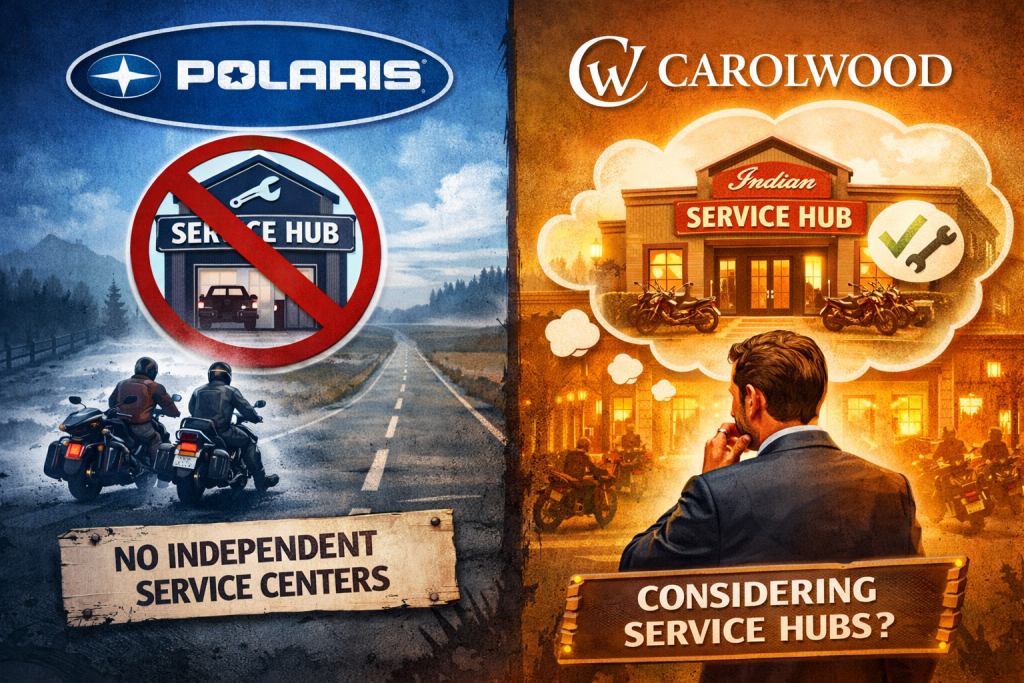
Under Indian Motorcycles LLC, directed for many years by Polaris, the brand followed a strict dealership-only service philosophy.
That decision had clear consequences:
- Independent service garages were not licensed
- Warranty and recall work was tightly restricted
- Skilled mechanics outside the dealer network were excluded
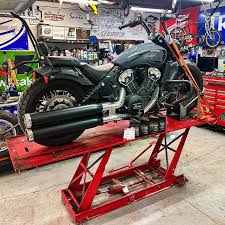
- Riders were left travelling excessive distances for routine care
This was not due to a lack of capable workshops — it was policy.
The Missed Opportunity: Independent Service Support
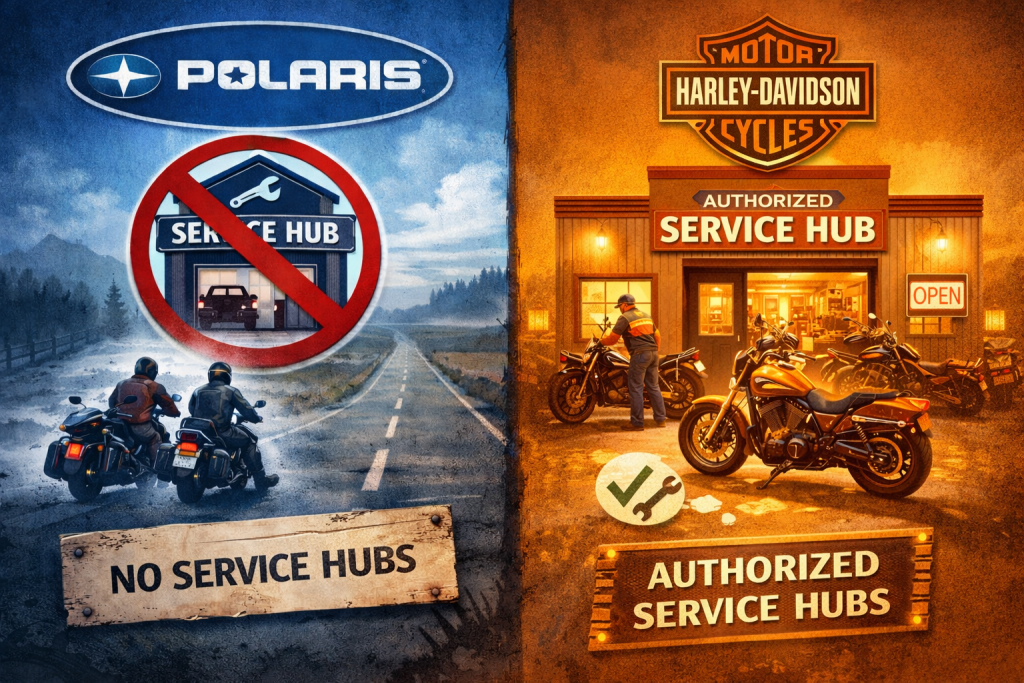
In contrast, Harley-Davidson has long supported:
- Licensed independent garages
- Warranty-authorised service centres
- A culture where independents are not actively obstructed
The result is tangible and rider-visible:
- Wider service coverage
- Shorter travel times
- Higher ownership confidence
- Stronger rider retention
This difference is not theoretical. Riders experience it every day.
Why This Affected Sales — Without Needing a Spreadsheet
You don’t need internal sales figures to see the pattern:
- Riders hesitate to buy when the nearest service point is hours away
- Servicing gets delayed
- Warranty confidence drops
- Bikes sit unused
- Owners quietly leave the brand
It is plain to see that insufficient service coverage makes Indian ownership less attractive — particularly for touring riders, rural owners, and customers who value long-term support as much as performance.
Service Hubs: The Solution That Was Overlooked
IMRGlobal has consistently highlighted service-only hubs as the missing piece.
These are not dealerships.
They are not sales outlets.
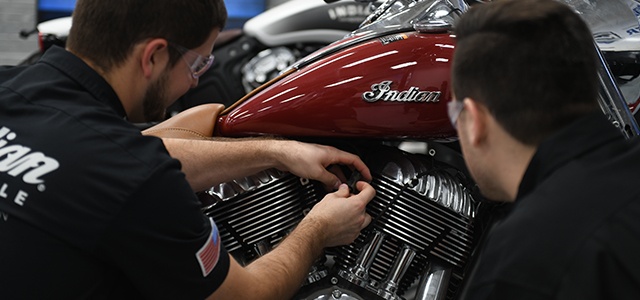
They are experienced, accredited service centres with clearly defined capability levels, operating under manufacturer oversight.
Modern training is already:
- online
- diagnostics-led
- supported remotely by technical teams
In practical terms, this means a service hub programme could be deployed quickly and cost-effectively.
A Sensible, Scalable Model
A tiered Service Hub framework could include:
Level 1 – Basic Service
- Routine servicing
- Tyres and brakes
- Diagnostics and software updates
Level 2 – Advanced Service
- Electrical fault-finding
- Warranty work
- Recall execution
- Suspension and drivetrain
Level 3 – Regional Master Hub
- Complex technical cases
- Technician mentoring
- Regional fast-moving parts support
All hubs would be accredited, audited, and supported by Indian Motorcycles LLC.
The objective is simple and measurable:
No Indian owner should be more than 1 – 2 hours from qualified service support.
Signs of Progress — But Not at the Required Pace
It is positive to see new dealerships still opening:
- Blue Mountain Indian Motorcycles opened on 6 January in the United States
- In the UK, there is discussion around Wales, with BMW Cardiff potentially operating as a service-focused location
Within the UK motorcycle industry, there has been increasing discussion around the possibility of established multi-brand operators stepping into service-first roles for Indian Motorcycle, with one name that continues to surface being BMW Motorrad Cardiff.
At this stage, IMRGlobal stresses that this remains industry speculation, not confirmation. However, the discussion itself is telling — and reflects a broader shift in how manufacturers may need to approach network growth.
IMRGlobal also notes that after formally raising the service hub concept with Polaris prior to the sale announcement, a service hub appeared in Scotland.
This suggests the message is being heard — but rollout speed remains critical.
IMRGlobal Engagement With Carolwood
As part of this transition period, IMRGlobal has formally written to Carolwood, outlining the urgent need for a licensed service hub scheme to be rolled out as soon as possible.
The proposal submitted by IMRGlobal includes:
- accrediting experienced independent service garages
- tiered service capability (from routine servicing to major repairs)
- central technical oversight by Indian Motorcycles LLC
- rapid deployment using existing digital training and remote technical support
The aim is clear and rider-focused:
To ensure every Indian owner has access to qualified support within approximately 1 – 2 hours of where they live.
This approach allows Indian Motorcycle to strengthen rider confidence quickly, without relying solely on the slower and more costly development of full dealerships — particularly important in the current global
Transparency, Accountability & Next Steps
At the time of writing, IMRGlobal is awaiting a response from Carolwood.
In the interests of transparency and community trust:
- Any reply or engagement will be shared with the Indian riding community
- Progress — or lack of it — will be reported openly through IMRGlobal Research
- Rider experiences will continue to inform and shape recommendations
IMRGlobal’s role is not to obstruct growth, but to support it by ensuring ownership is practical, sustainable, and properly supported.
IMRGlobal’s Position
Indian motorcycles deserve:
- skilled hands
- local support
- realistic ownership conditions
Service access is not a luxury — it is a foundation of trust.
If Indian Motorcycle is to thrive globally as a standalone brand, it must ensure that owning one is not only desirable — but workable.
IMRGlobal Research will continue to amplify rider experience, highlight structural issues, and advocate for solutions that keep riders safely and confidently on the road.
5 Responses
Hello,
Thank you for this insightful article highlighting a critical issue: access to qualified service is central to the Indian Motorcycle ownership experience.
I fully agree with this analysis — this is not an isolated issue, but a structural one. In many regions, potential buyers hesitate to choose Indian Motorcycle not because of the product itself, but because after-sales service and technical support are too distant or limited. This directly impacts long-term confidence in the brand.
At Légende Cycle inc. (independent), Quebec, we see this reality every day on the ground. Customers often make their purchasing decisions based on service accessibility rather than specifications alone. This confirms that service is not a secondary consideration, but a strategic pillar for customer satisfaction and brand loyalty.
➡️ A constructive path forward would be to complement dealership expansion with a certified network of specialized independent service centers. This would reduce geographic gaps, improve customer experience, and strengthen trust in the brand. Similar models have proven effective in other premium motorcycle segments.
Thank you for bringing this important discussion to the forefront.
— Michel L.
Légende Cycle inc. (independent), Quebec
Thank you for your comment, it is something we have asked Polaris a few times over the last two years due to the decline of the dealerships, also we have tried to make contact with Carolwood but nothing back as yet. I did have a sit down meeting with Indian UK a couple of years ago and they stated that there were no plans to have service hubs or to engage with independent garages which is very short sighted. Protecting the dealerships but not the customers that love their product and buy it, thinking upside down in my opinion.
I agree
As a BMW and other certified MC technician, and an independent service shop (since the 1970’s), my fellow independent service shops have been retiring, and like myself, they take the decades of direct experience and craft with them. I am hard-pressed to find younger apprentices with the same “passion” to invest in a career (not a job) in the many aspects of being a quality motorcycle mechanic. I have been fortunate to have extensive computer design/development, CAD/CAM engineering, CNC machinist, racecar fabrication, and factory training. Frankly, I can choose my customers, but I am also retiring, so the vetting of independent shops (more importantly, the technicians), would be the real challenge.
That’s where owner groups come into play where they already use independents but with no support, which there are quite a few gifted ones around.