The Floyd Clymer Era (1963 - 1970)
The Motorcycles
When Floyd Clymer secured the Indian name in the early 1960s, motorcycles did not appear overnight. The first years were spent navigating the trademark, rebuilding a dealer network, and developing a product range from scratch without a factory, without an engine, and without the infrastructure that any serious manufacturer would take for granted.
It was not until 1967 that Indian-branded machines began reaching American dealers in any meaningful volume, operating under the Floyd Clymer Motorcycle Division from premises on North Virgil Avenue in Los Angeles. The minibike range came first — practical, affordable, and shrewdly aimed at introducing a new generation of riders to the Indian name. The full-size machines followed in 1969, serious motorcycles built in Bologna and powered by British engines that represented the most credible attempt to revive Indian as a real motorcycle marque since Springfield had closed sixteen years earlier.
By early 1970, the operation was in the process of being renamed Indian Motorcycle Company — a signal that Clymer believed he was finally close to something permanent. He never got there. He died in January 1970, and with him went the plans, the momentum, and the ambition that had driven the whole project forward.
There was more to come. Time simply ran out.
Indian Papoose (1967–1970)
Engine: 50cc Minarelli P4S · 4-speed · Top speed: 47mph Built by Italjet, Bologna, Italy
The Papoose was the machine that kick-started the Clymer era. Small, affordable, and wearing the Indian name proudly on its tank, it was aimed squarely at introducing a younger generation of American riders to the brand. Clymer initially distributed them as promotional gifts to dealers he was signing up for the larger Indian models in development — but demand quickly outgrew that strategy. Italjet ultimately built more than 15,000 Papooses for the American market, making it by far the most commercially successful product of the entire Clymer period. It was never going to satisfy those who remembered the Scout and the Chief, but it kept the name in showrooms, in garages, and in front of American riders at a time when Indian needed every friend it could find.
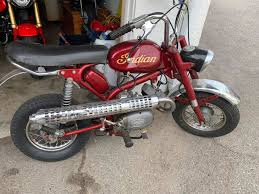
Indian Pony Bike (1967–1970)
Engine: 50cc Minarelli P4S · 3-speed · Top speed: 47mph Built by Italjet, Bologna, Italy
Where the Papoose was unashamedly a minibike, the Pony Bike took a step toward something that looked and felt more like a real motorcycle. Longer, more upright, and styled with a proper fuel tank and seat unit, it appealed to younger riders who wanted the Indian name without the compromises of the smallest machines in the range. Sharing the same Minarelli engine as the Papoose but fitted with a 3-speed gearbox, it sat in the middle of the Clymer small-displacement lineup — practical enough for everyday use and stylish enough to turn heads. Like everything in the range it was built by Italjet in Bologna, part of Clymer’s growing partnership with Leopoldo Tartarini that would eventually produce far more ambitious machines.
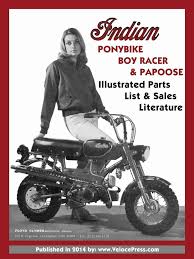
Indian Boy Racer (1967–1970)
Engine: 50cc Jawa · 3-speed · Top speed: 50mph Built by Italjet, Bologna, Italy
The Boy Racer wore its intentions on its sleeve. Where the Papoose and Pony Bike were aimed at everyday riders and younger enthusiasts, this was built for those who wanted something with a competitive edge. The racing number board, flat seat, and aggressive stance gave it a genuine scrambler personality, and the Jawa 50cc engine — rather than the Minarelli unit used elsewhere in the range — gave it a slight performance advantage over its stablemates, nudging the top speed to 50mph. It was the most sporting machine in the small-displacement Clymer lineup and remains one of the more visually striking Indians of the entire era. Rare today, a well-preserved Boy Racer in original condition is a genuine collector’s piece.
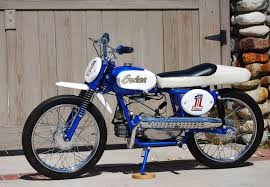
Indian Super Scrambler (1969–1970)
Engine: 50cc Minarelli P4S · 4-speed · Off road Built by Italjet, Bologna, Italy
The Super Scrambler was the dirt-focused member of the Clymer family and made no apologies for it. High-mounted exhaust, long-travel suspension, knobbly tyres, and a lightweight stripped-back build gave it genuine off-road capability that the street-oriented models in the range simply weren’t designed for. It arrived late in the Clymer era — 1969 — giving it barely a year of production before Clymer’s death brought everything to a halt. That short window makes surviving examples genuinely rare today. As the only dedicated off-road Indian of the entire post-Springfield period, it occupies a unique place in the marque’s history — a small machine with a surprisingly significant story.
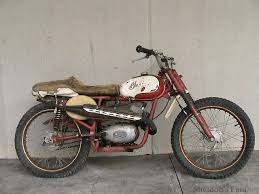
Indian Scrambler 100 (1969–1970)
Engine: 100cc Minarelli · 4-speed · Dual purpose Built by Italjet, Bologna, Italy
The Scrambler 100 represented the top of the small-displacement Clymer range and a genuine step forward in ambition. Doubling the engine capacity of the 50cc machines to a 100cc Minarelli unit, it bridged the gap between the minibike lineup and the full-size machines that Clymer was developing in parallel. Capable enough for light trail riding yet practical on the street, it appealed to a broader audience than the purely off-road Super Scrambler. Like its stablemates it arrived late — 1969 — and had barely a year in production before Clymer’s death ended the programme. A well-preserved Scrambler 100 is among the more desirable survivors of the Clymer era, representing the point at which the small-displacement Indian range was finally beginning to grow into something more substantial.
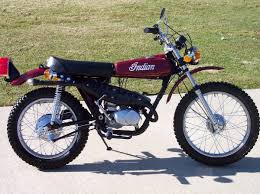
Indian Bambino (1969–1970)
Engine: 50cc Franco Morini S5K · All-chrome exhaust Built by Italjet, Bologna, Italy
The Bambino was the last addition to the Clymer small-displacement range and in many ways the most refined. Where the Papoose and Pony Bike used Minarelli engines, the Bambino was fitted with a Franco Morini S5K unit — a smooth, reliable little engine that was earning a strong reputation across the Italian small-bike industry at the time. The all-chrome exhaust gave it a distinctive and polished appearance that set it apart from its stablemates, and its compact proportions made it an appealing entry point for younger riders. Arriving in 1969 alongside the Scrambler 100 and Super Scrambler, it was part of Clymer’s push to broaden the Indian range in the final year of his life. Like everything that came late in the Clymer era, it had barely found its feet before his death in January 1970 brought production to an abrupt end.
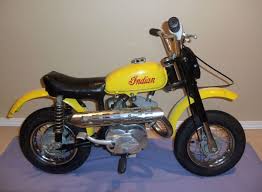
Indian Enfield Interceptor 750 (1969–1970)
Engine: Royal Enfield Interceptor MkII 750cc parallel twin · Italjet Griffon-based chassis Built by Italjet, Bologna, Italy · Approximately 50 produced
This is where Clymer’s ambition moved beyond minibikes and into something genuinely serious. The Interceptor 750 was a proper motorcycle in every sense — Leopoldo Tartarini’s beautifully engineered Italjet chassis wrapped around the Royal Enfield Interceptor MkII parallel twin, producing a machine that was lighter, better handling, and more visually striking than almost anything else available at the time. The Indian script appeared on both the tank and the engine cases, and the overall package was a credible, modern motorcycle that deserved far greater recognition than history has given it.
Only around 50 were built. Clymer had ordered a larger supply of Royal Enfield Interceptor engines, but his death in January 1970 stopped production before the full run could be completed. The remaining engines were acquired by Rickman, where they found a second life in an entirely different chassis. Surviving examples are exceptionally rare today and among the most collectible machines of the entire post-Springfield Indian story.
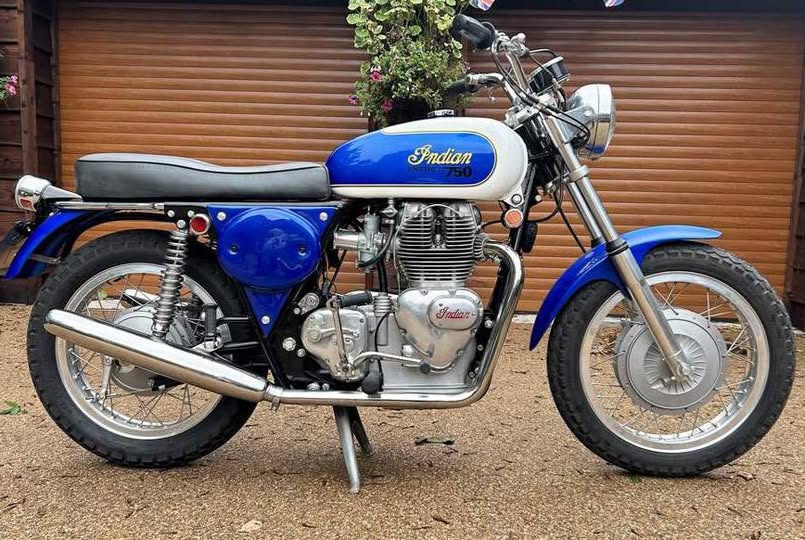
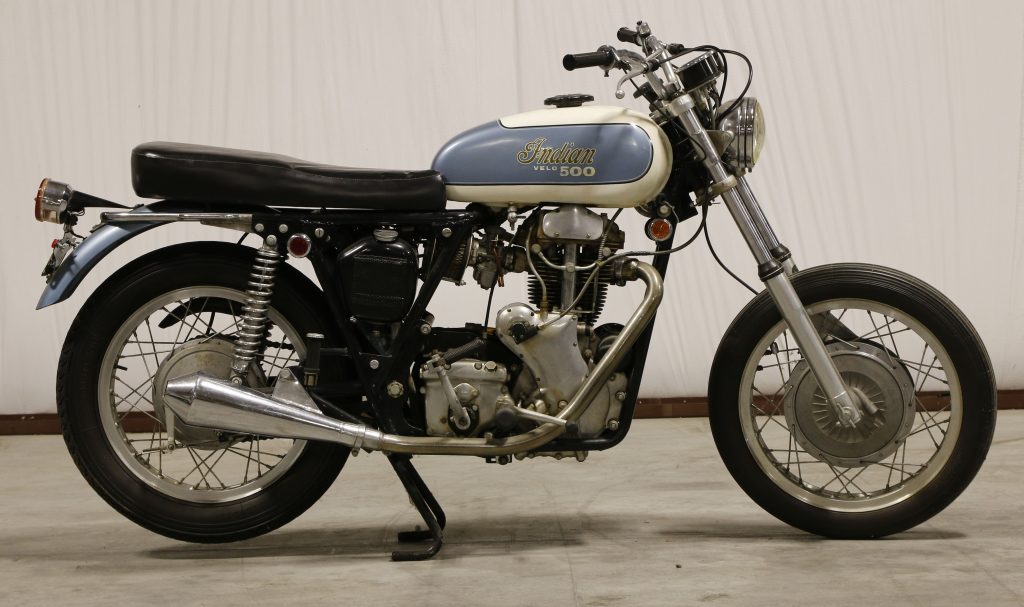
Indian Velo 500 (1969–1970)
Engine: Velocette Venom/Thruxton 500cc OHV single · 41bhp · 4-speed Frame: Italjet tubular steel double cradle ·
Marzocchi suspension front and rear Wheels: Borrani aluminium rims · Grimeca brakes Built by Italjet, Bologna, Italy · Approximately 200 produced — 150 to USA, 50 to UK
The Velo 500 was the finest machine the Clymer era produced and arguably one of the most underrated motorcycles of its generation. Leopoldo Tartarini’s purpose-built double cradle chassis — lighter, stiffer, and more refined than anything Velocette itself was offering — was mated to the legendary 500cc Venom and Thruxton single-cylinder engine, producing a motorcycle that period riders consistently described as better handling than the Velocette it drew its power from. The weight saving alone was remarkable — nearly 45 pounds lighter than a standard Venom — and combined with Marzocchi suspension at both ends, Borrani aluminium rims, and Grimeca brakes, the result was a machine that felt genuinely modern in a way that most British motorcycles of the period simply did not.
Around 200 were built in total, with engines shipped from Wolverhampton to Bologna where Tartarini’s team completed the assembly. One hundred and fifty went to the United States, fifty remained in Britain, sold through London dealer Geoff Dodkin. Both Velocette and Clymer died in 1970, and with them went any prospect of the Velo 500 reaching the production numbers it deserved.
A surviving example in good original condition is among the most historically significant motorcycles of the entire post-Springfield Indian story — a genuine what-might-have-been machine that deserved a far longer life than fate allowed.
Prototypes — Never Reached Production
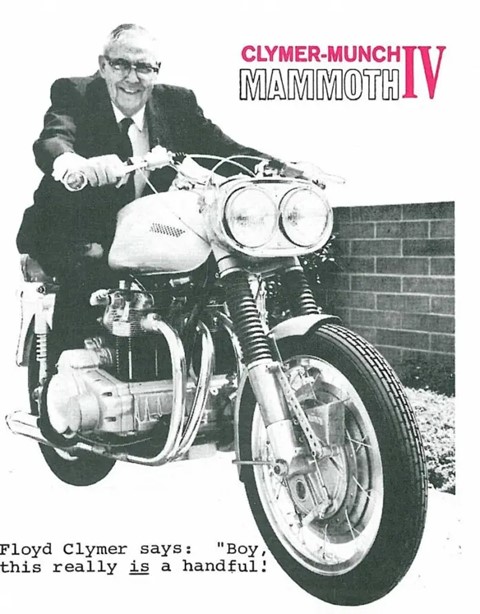
Indian Münch Mammoth (1967)
Engine: NSU 1200cc car-derived four-cylinder · German-built Münch chassis One or two units only
When Clymer became the sole American importer of the German-built Münch Mammoth in 1967, he saw an opportunity. The most powerful motorcycle of its era, with a 1200cc NSU car engine producing performance that nothing else on the road could match, it was exactly the kind of statement machine the Indian name needed. Clymer marketed it as the Ferrari of motorcycles and briefly promoted it under Indian branding. The $4,000 price tag — astronomical for the period — made it essentially unsellable, and the project went no further. A fascinating footnote rather than a genuine revival, it nonetheless illustrates the scale of Clymer’s ambition and his determination to associate the Indian name with the very best motorcycles in the world.
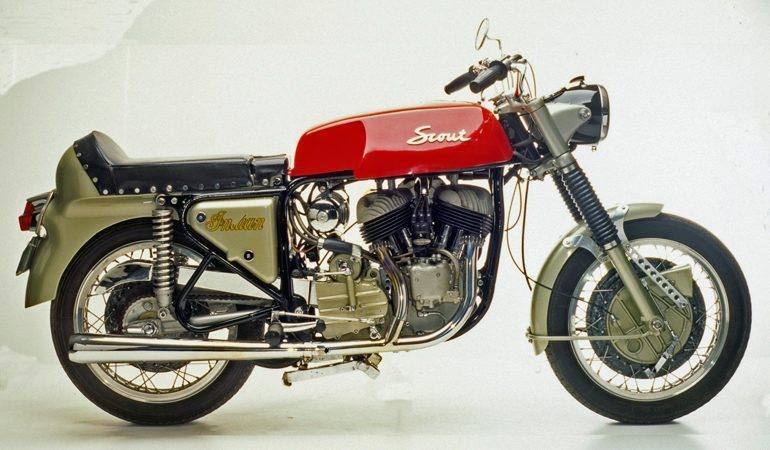
Indian Scout Prototype (1968)
Engine: Updated 750cc Sport Scout sidevalve V-twin · Friedl Münch chassis One prototype built
This was the closest Clymer ever came to building a genuine American Indian. Working with Friedl Münch in Germany, he commissioned a prototype using an updated version of the legendary Indian Scout sidevalve V-twin engine — the engine that had defined Indian’s character for decades — housed in a modern Münch rolling chassis. The combination of heritage engineering and contemporary German chassis technology was an intriguing proposition, but cost analysis proved fatal. Manufacturing it at a price that would generate any profit was simply not achievable, and the project was abandoned after a single prototype. That prototype survived and was sold in 2009 to a collector capable of returning it to running condition. It remains the only physical evidence of what a Clymer-era big Indian might have looked like.
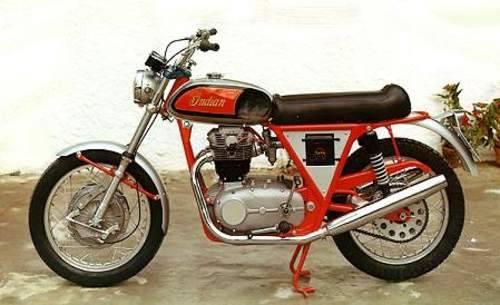
Indian Horex (late 1960s)
Engine: Horex 500cc parallel OHC twin · Italjet chassis One prototype only
The Horex Indian is one of the great lost motorcycles of the Clymer era — and arguably the most beautiful machine he ever put the Indian name on. Clymer acquired a supply of Horex 500cc parallel overhead cam twin engines, a unit produced in both 400cc and 500cc forms and considered genuinely advanced for its time. Horex had a complicated history — the German manufacturer never quite broke through commercially and had ceased production in 1958 — but the engines that remained were capable, refined units that deserved a better fate than obsolescence.
Tartarini built one prototype, housing the Horex twin in his characteristic Italjet chassis, and the result was striking. Light, elegant, and powered by an engine with real character, it represented exactly the kind of machine Clymer had been working toward. But with Velocette singles still in production and Royal Enfield Interceptor engines secured for the 750, the Horex became redundant before it could be developed further. Only one was ever built. It survives today as a unique and largely unknown piece of Indian Motorcycle history — a one-of-a-kind prototype that deserved far more than the footnote history has given it.
Prototypes — Never Reached Production
For all the commercial pragmatism of the minibike range, Floyd Clymer never lost sight of his ultimate ambition — a full-size American Indian motorcycle built to modern standards. These machines represent that dream in its most tangible form. None reached production. Each tells its own story of what might have been.